Erin Pollina put together some pretty interesting analysis of young and inexperienced teams in the NHL, and how they react to the playoffs.
A lot of the stuff she came up with are things that I've been harping around here.
Here's a copy of the article and chart:
Quote:
Patrick Kaleta said it was desperation, Paul Gaustad cited inconsistency, and Henrik Tallinder wondered if a little bit more determination would have helped the Buffalo Sabres advance to the second round of the Stanley Cup Playoffs.
While those, and several other factors – including the power play – may have played a part in seeing the Sabres eliminated from the postseason, what if the answer were a little more simple?
Before I begin, here is my disclaimer – This is only a theory. As fans rack their brains trying to pinpoint what went wrong in an otherwise successful season, I wanted to go into the numbers and, perhaps, offer some hopeful speculation.
With that being said, my question is this – what if the answer isn’t that the Sabres ‘weren’t built for the playoffs’ as some pundits have suggested? What if they simply weren’t ready?
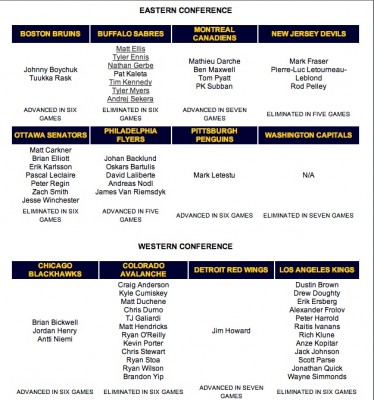
The Sabres had seven players on their roster that made their postseason debut in the 2010 playoffs. That’s nearly a third of the lineup that was untested going into the first round. It was also the highest in the Eastern Conference. The only team that equaled the Sabres' inexperience was Buffalo’s division rival, the Ottawa Senators.
Perhaps not surprisingly, both teams were eliminated after just six games.
After looking at all 16 NHL teams in the playoffs, I found that the trend continued. The teams that had the most players on their roster without any prior postseason experience were typically out after the first round.
Here’s how it breaks down:
The Los Angeles Kings and Colorado Avalanche topped the list with 12 playoff rookies each. They were followed by the Nashville Predators [8], Senators and Sabres in that category.
Again, all six of these teams didn’t make it out of the Conference Quarterfinals.
The Phoenix Coyotes had six players growing their playoff beards for the first time, to Detroit’s Jimmy Howard. And while they were the lower seed in the Western Conference compared to their opponent, the Red Wings still beat the Coyotes in seven games.
While the theory may not account for every team in the NHL, it seemed that it was growing pains that inevitably caused these teams to fall to their more experienced counterparts.
There were some exceptions.
Every player on the Washington Capitals had played in at least one playoff game, yet they fell to the Montreal Canadiens, who had four rookies, in seven games. The Philadelphis Flyers, with five new players, also beat the New Jersey Devils, who only had three players making their post-season debuts.
“I think you learn from every experience,” said Jason Pominville. “We hadn’t been in the playoffs for a little while. I think the biggest thing is pushing each other to be better and go out in the summer to improve your game.”
“I know when I was younger, when you go through a tough playoff series and you don’t come out on top – sometimes you learn form it,” said Mike Grier. “You go home and you feel like you’re a better hockey player. You want to get back at it, you know what you have to work on and I think it will be a good experience for a lot of guys.”
It could be that the Buffalo Sabres needed to endure this year’s disappointment in hopes of being prepared for future endeavors. It doesn't make the loss to the Bruins sting any less, but with more young players exposed to the postseason, maybe next year will have a different result.
Check out the chart below for a more complete breakdown:
Attachment:
 1A.jpg [ 190.77 KiB | Viewed 2502 times ]
Attachment:
 1B.jpg [ 160.18 KiB | Viewed 2502 times ]

 Login
Login Register
 FAQ
FAQ Search